
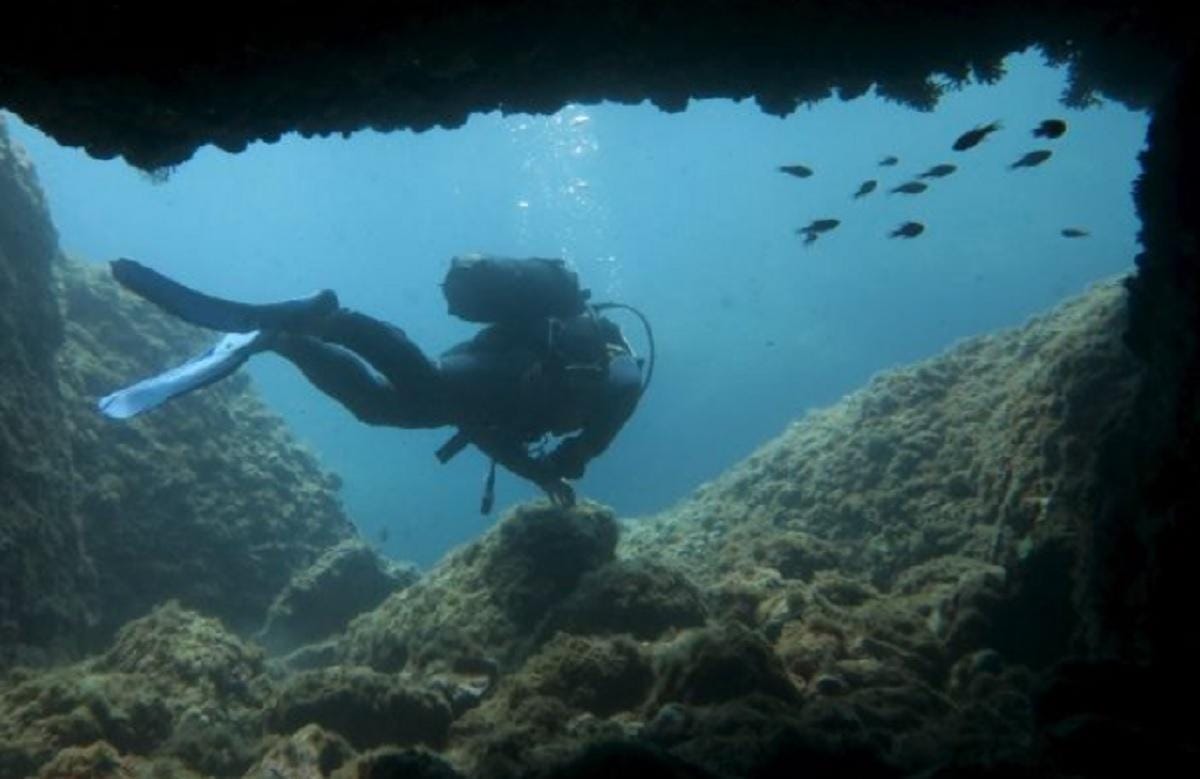

Off the coast of Sardinia, a diver found a unique treasure at the bottom of the sea among the sea grass. It was made up of between 30,000 and 50,000 bronze and copper coins (folis) from the late Roman period. Popular Mechanics says that the Italian Ministry of Culture has called this find one of the most significant numismatic discoveries of recent years. All the coins are from 324–345 AD and are in perfect condition. They also found bits of amphorae, which suggests there might have been a plane crash or a shipwreck in the area, but they haven’t found the ship itself yet. Even though the diver found the treasure, he didn’t get any money for it. The court said he couldn’t be paid because his metal detector had been taken away. This meant that his search in the area, which was important in history, wasn’t just by chance.
It all started when a diver saw something metal in the seaweed off the coast of Sardinia. This led the researchers to a much larger treasure: tens of thousands of bronze follis coins from the late Roman period. The Romans and later the Byzantine Empire used Follis coins made of bronze and copper. Italy’s Ministry of Culture has estimated the total number of coins at over 30,000, and possibly as many as 50,000, according to Popular Mechanics.
Luigi La Rocca, the region’s director general of archaeology, fine arts, and landscape, said that the treasure found in the waters off Sardinia is one of the most significant numismatic discoveries of recent years.
Divers retrieved the coins, which, according to the ministry, are in “excellent and rare condition.” Scientists reckon they were around from 324 to 345 AD.
The Italian Ministry of Culture thought that a sunken ship might explain why there are coins off the coast of Sardinia. The scattered coins were found in two large areas between the beach and the seagrass beds. Divers also found bits of narrow-necked amphorae. So, all this might suggest a scenario involving a sunken ship, but there’s no scientific proof of this yet.
How did the coins end up being found?
Well, it all started when a diver spotted a few coins on the seabed. He got in touch with the authorities, and soon after, a team of underwater archaeologists was sent out to get the treasure.
But the diver who found the coins won’t be getting a reward. The court rejected his claim for payment because the discovery wasn’t considered to be an accident – the man was found to have a metal detector, and there was evidence that the area might be of archaeological significance.