
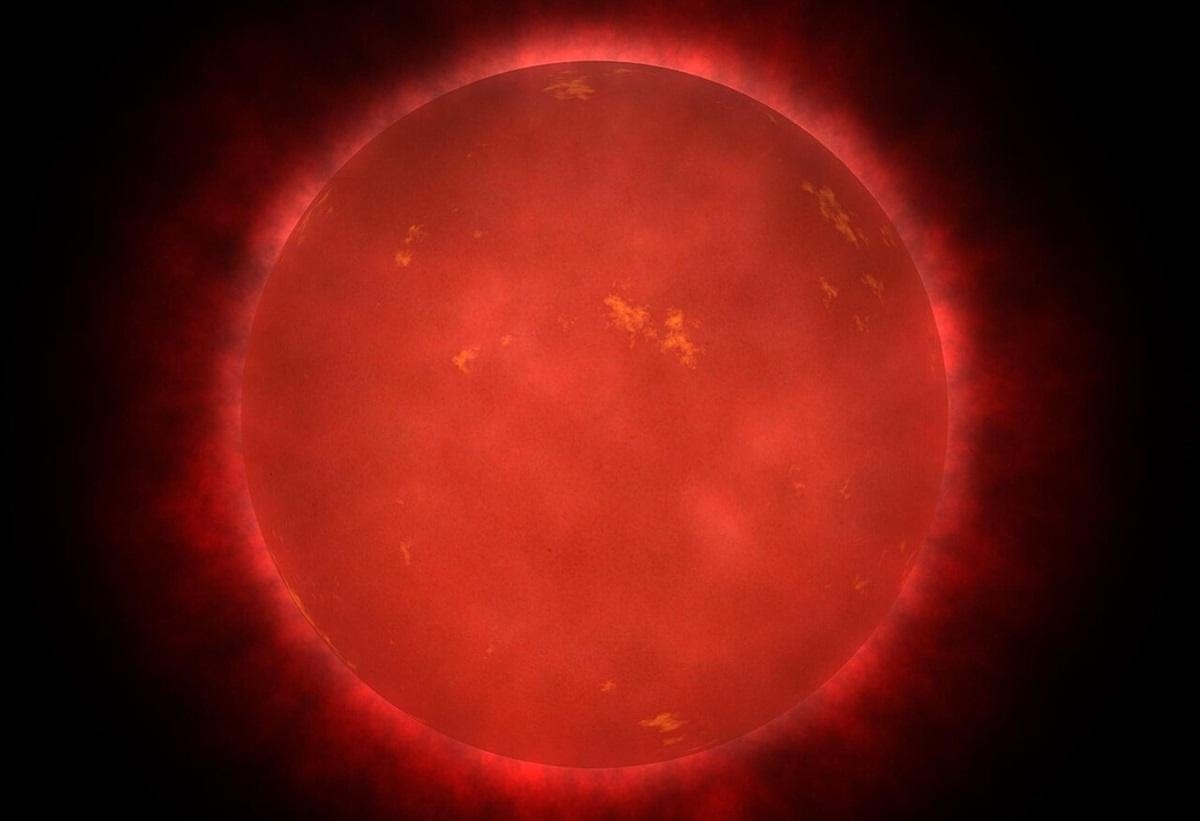

We’ve found a new super-Earth named Ross 318 b in our galaxy using the radial velocity method. They figured this out after studying 15 years of data from the CARMENES and HIRES spectrographs. These tools recorded the gravitational wobbles of the host star, which is an active red dwarf called Ross 318. The planet takes 39.63 days to go around its star, and it’s 0.16 AU away. It’s 6.21 times heavier than Earth and 1.74 times wider. The super-Earth’s equilibrium temperature is estimated to be about -36 °C (237 K). The main feature of Ross 318 b is tidal locking, which means the planet rotates around its axis at the same speed as it orbits the star. Because of this, one side is plunged into eternal night, while the other is always facing the sun. Scientists are still trying to figure out if the planet is rocky and if it’s managed to keep an atmosphere, even with the magnetic flares from its dwarf star.
We’ve found a new super-Earth in our area. A super-Earth is a planet with a mass greater than Earth’s but less than Neptune’s. Spider’s Web says that its existence is shown by a slight change in the motion of a nearby star.
We’ve got a new planet in the system, and it’s called Ross 318 b. The scientists figured this out using the radial velocity method.
The article mentioned that a planet’s gravitational pull on a star is very slight. So, the star isn’t perfectly still — it wobbles a bit because of its companion.
You can spot these wobbles in a star’s light spectrum. When a star moves closer or farther away from us, these lines shift a bit.
For Ross 318 b, the researchers looked at archival data from the CARMENES and HIRES spectrographs, covering about 15 years of observations. The article mentioned that the star Ross 318 is an active red dwarf. These stars often have spots, flares, and magnetic activity that can mimic a planet’s signal.
The publication also mentioned that red dwarfs are cooler, smaller, and dimmer than the Sun, but they’re pretty common in the Milky Way. Ross 318 has an effective temperature of about 3,450 K, which is significantly lower than the Sun’s, and its rotation period is about 51.5 days.
Here’s what we know about Ross 318 b
- Scientists say it takes 39.63 days for Ross 318 b to make one full orbit around its host star. It’s got at least 6.21 times the mass of Earth, so it’s a super-Earth.
- Ross 318 b is about 1.74 times the size of Earth’s orbit. The planet is about 0.16 astronomical units (or about 24,000,000 km) from its star.
The planet’s equilibrium temperature is estimated at approximately 237 K, or about -36 °C. This is a theoretical value based on the radiation balance, without considering the greenhouse effect, clouds, atmospheric composition, or heat distribution. For comparison: Earth’s equilibrium temperature is about -18 °C.
The article said that the main thing about Ross 318 b is how it rotates. It spins around its axis at the same speed as it goes around its star. The Moon also has a similar effect, and it’s always visible from Earth from the same side.
Scientists are keen to learn more about Ross 318 b. So far, it’s unclear if it’s rocky or if it’s kept an atmosphere even with the red dwarf’s magnetic activity.