
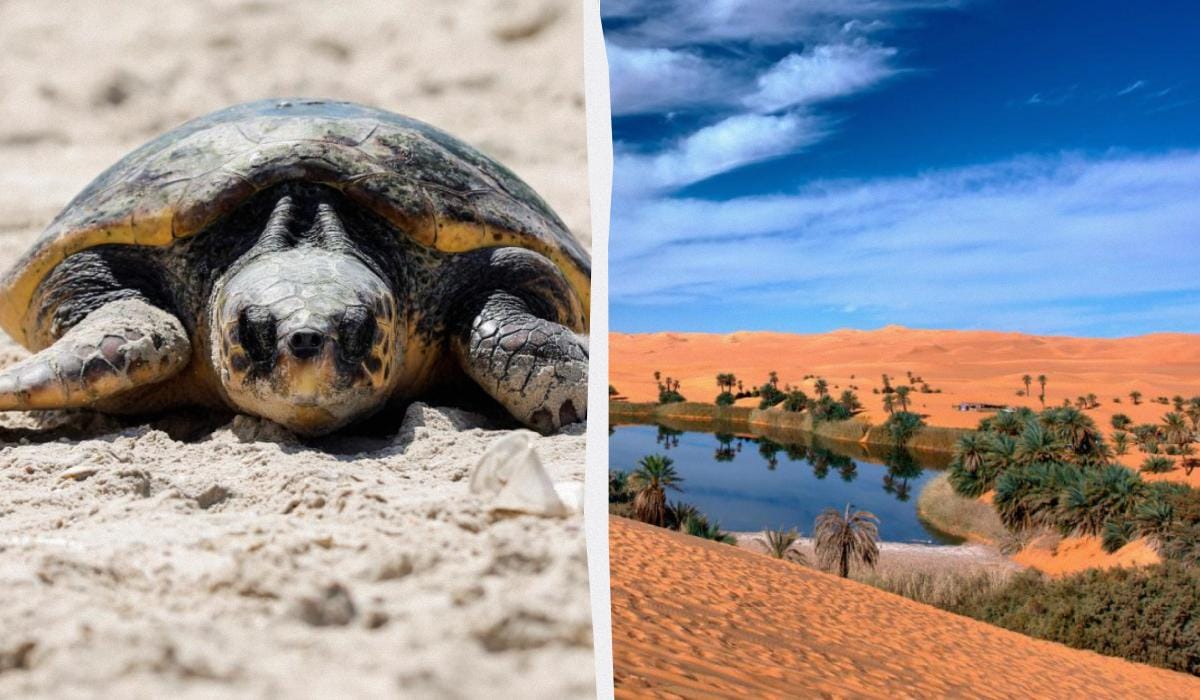

Ecological experiment conducted in 2021 released 500 African spurred tortoises (Centrochelys sulcata) into the degraded Sahel region, successfully triggering the revival of local vegetation. In an area where daytime temperatures surpass 140°F, the soil forms a hardened crust that causes rainwater to evaporate instantly. By digging deep shelters of up to 10–15 meters to escape the heat, the tortoises fracture the compact crust. This allows rainwater to penetrate the soil instead of washing away. This wakes dormant seeds and builds miniature, moist oases teeming with insects and microorganisms. While scientists from the IUCN and organizations like S.O.S. (Save Our Sulcatas) emphasize that these “ecosystem engineers” cannot single-handedly stop desertification, satellite imagery has tracked distinct green patches reappearing in the sand through natural habitat restoration.
The soil in the Sahel region, south of the Sahara, is so dry that it forms a hard crust. Temperatures often exceed 140°F during the day, while the air cools sharply at night. Under these conditions, rainwater evaporates almost instantly instead of penetrating the ground, and seeds can no longer germinate.
In 2021, researchers tried an unusual solution. They released 500 spur-thighed tortoises onto a degraded plot of land near the southern edge of the Sahara. This species, Centrochelys sulcata, is perfectly adapted to life in extreme heat and drought conditions. Five years later, satellite images revealed green patches scattered across the sand, according to Antena 3 CNN. The tortoises hadn’t planted anything.
However, they did what they do instinctively: they dug burrows
This behavior is remarkable because the spur-thighed tortoise is the largest land tortoise in the world and the third largest on the planet after the Galápagos and Aldabra tortoises. Males can weigh over 100 kilograms.
It is not their size, however, that has altered the landscape, but rather their habit of digging deep burrows to escape extreme temperatures. These tunnels can extend 10–15 meters underground, breaking up the compacted soil crust.
Once this crust cracks, rainwater seeps into the soil rather than running off the surface. The soil retains moisture longer, and dormant seeds begin to germinate.
This phenomenon has already been observed in Senegal, where the organization S.O.S. (Save Our Sulcata) has run turtle breeding and reintroduction programs since 1992. A report by the International Union for Conservation of Nature (IUCN) showed that the Village des Tortues reserve in Noflaï housed over 300 turtles, some of which were later released into the wild.
The process by which a burrow becomes a small oasis is as follows: Turtles do not intentionally spread seeds nor do they “plant” vegetation. However, the loosened soil around the burrow entrances creates a stable microclimate where moisture is retained longer.
It is there that the first plants begin to appear
Over time, insects and microorganisms colonize the moister soil, and the ecological chain gradually recovers.
Ecologists refer to such animals as “ecosystem engineers” because they physically alter the environment in a way that helps other species survive.
A 2017 study published in the journal Frontiers in Ecology and Evolution highlighted the enormous potential of the spur-thighed tortoise in this regard, particularly in semi-arid areas where water and vegetation are scarce.
No machinery, irrigation, or chemicals were used
The project, launched in 2021, attracted international attention, though attempts to reintroduce the tortoises in Senegal began long before that. In some monitored groups, over 80% of the animals survived for four years.
The researchers emphasized that no machinery, irrigation systems, or chemical soil treatment was used to plant the trees. The only intervention was the reintroduction of a native species that had disappeared from many areas due to hunting, intensive agriculture, and overgrazing.
Gradually, vegetation began to return to areas that had previously been nothing but sand. These are not forests, but rather patches of biodiversity visible even from space around the burrows dug by the tortoises.
However, scientists warn that tortoises are not a miracle solution to desertification in the Sahara. The Sahel region suffers from drought, climate change, overgrazing, and habitat fragmentation.
Furthermore, the tortoise species itself, which is currently helping to restore vegetation, is endangered. The IUCN lists the spur-thighed tortoise as a species at risk of extinction, and its population is rapidly declining across its natural range.
Approximately 60% of these threats are linked to habitat destruction, while the rest are due to climate change, hunting, and the illegal exotic animal trade.
Researchers noted that such projects’ success continues to depend on rainfall, controlling livestock grazing, and long-term land management practices. However, the experiment demonstrated just how important a single species can be in restoring a virtually destroyed ecosystem.