
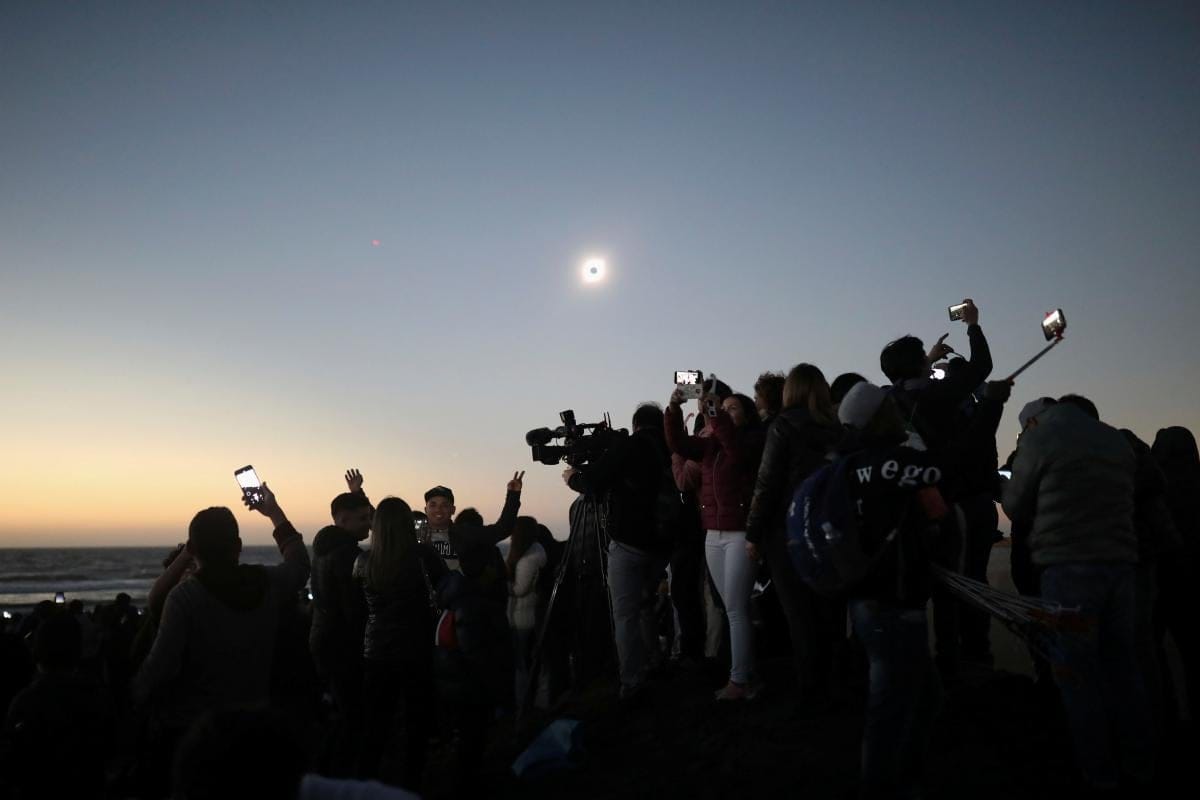

Earth’s going to experience a unique series of solar eclipses that’ll occur three years in a row: in 2026, 2027, and 2028. According to Blikk, the first of these is expected on August 12, 2026. The total phase, which will last 2 minutes and 18 seconds, will be visible in Iceland and Spain, while residents of Europe will be able to see an apocalyptic partial eclipse at sunset. The main event will be on August 2, 2027. Thanks to a rare astronomical coincidence, the total eclipse will last a record 6 minutes and 20 seconds for the 21st century. The shadow will pass over Spain, North Africa, and the Middle East, with the darkness lingering longest in Egypt (near Luxor). The series will end on January 26, 2028, with an annular eclipse (“ring of fire”), which will be visible in South America, Portugal, Spain, and Morocco. Experts remind everyone to use special protective glasses.
Earth is going to experience a unique series of solar eclipses for three years in a row—in 2026, 2027, and 2028. The big finale will be the 2027 eclipse, which is considered the second longest of this century, according to Blikk.
The first eclipse in the series is set to take place on August 12, 2026. Folks living in western Iceland and northern and eastern Spain will see it for themselves. There, the Moon will block the Sun and turn day into night for a few minutes. It’ll be about two minutes and 18 seconds.
There’ll be a partial eclipse visible in a bunch of European countries. The event starts in the evening around 7:10 p.m. and reaches its peak around 8:05 p.m., when the Sun turns a reddish-orange color. It makes the landscape look almost like the end of the world.
2027
The real climax is going to be on August 2, 2027. The total solar eclipse is going to last a record 6 minutes and 20 seconds, thanks to a unique alignment: Earth will be at its farthest point from the Sun, and the Moon will be at its closest point to Earth.
The path of total darkness will pass through southern Spain, North Africa, the Middle East, and Somalia. The darkness will be felt longest in Egypt—near Luxor.
Spain’s already gearing up for a tourism surge and has even set up a special government committee to handle the events.
2028
On January 26, 2028, a series of annular solar eclipses will come to an end. The Moon won’t completely cover the Sun, but there’ll be a bright “ring of fire” around it—still pretty impressive. You’ll be able to see it in Ecuador, northern Brazil, Portugal, Spain, and Morocco.
Experts say that looking at the Sun during an eclipse without the right protection can hurt your eyes. And don’t forget to use special eclipse glasses or filters.