

Scientists have found a new type of tiny octopus near the Galápagos Islands. It’s about the size of a golf ball and they’ve officially described it as Microeledone galapagensis. This creature was first spotted by an underwater robot in 2015, and it has a unique colouration: blue on top and dark purple on the bottom (likely to camouflage its bioluminescent prey from predators). Janet Voight, who works at the Field Museum of Natural History in Chicago, said that the mollusc is known for its very soft skin and short, thick tentacles with a single row of suction cups. As only one specimen was caught, the scientists decided not to do a traditional dissection. Instead, they used micro-CT scanning and a high-precision 3D model to examine the animal’s internal structure.
Blue on top, dark purple on the bottom, and about the size of a golf ball—near the Galápagos Islands on the ocean floor, researchers discovered a new species of octopus. Its short tentacles, which are only three to four centimetres long, have around 30 suction cups each, according to Der Spiegel.
This unusual creature was first spotted during an expedition in 2015, at a depth of nearly 1,800 metres, when scientists from the Charles Darwin Foundation were exploring the seafloor using a remotely operated underwater vehicle. At that time, they filmed three small octopuses and captured one female for further study. The new species has now been officially described in the scientific journal Zootaxa under the name Microeledone galapagensis.
“I just knew this was something really special,” said octopus expert Janet Voight, who was asked to ID the mysterious mollusc. The guy who looks after the Field Museum of Natural History in Chicago ended up being the main author of the scientific paper.
At first, the researcher only got hold of some photographs of the miniature octopus, and later its preserved body.
“When it arrived, I thought, ‘My God, it’s so beautiful’, says Voight.
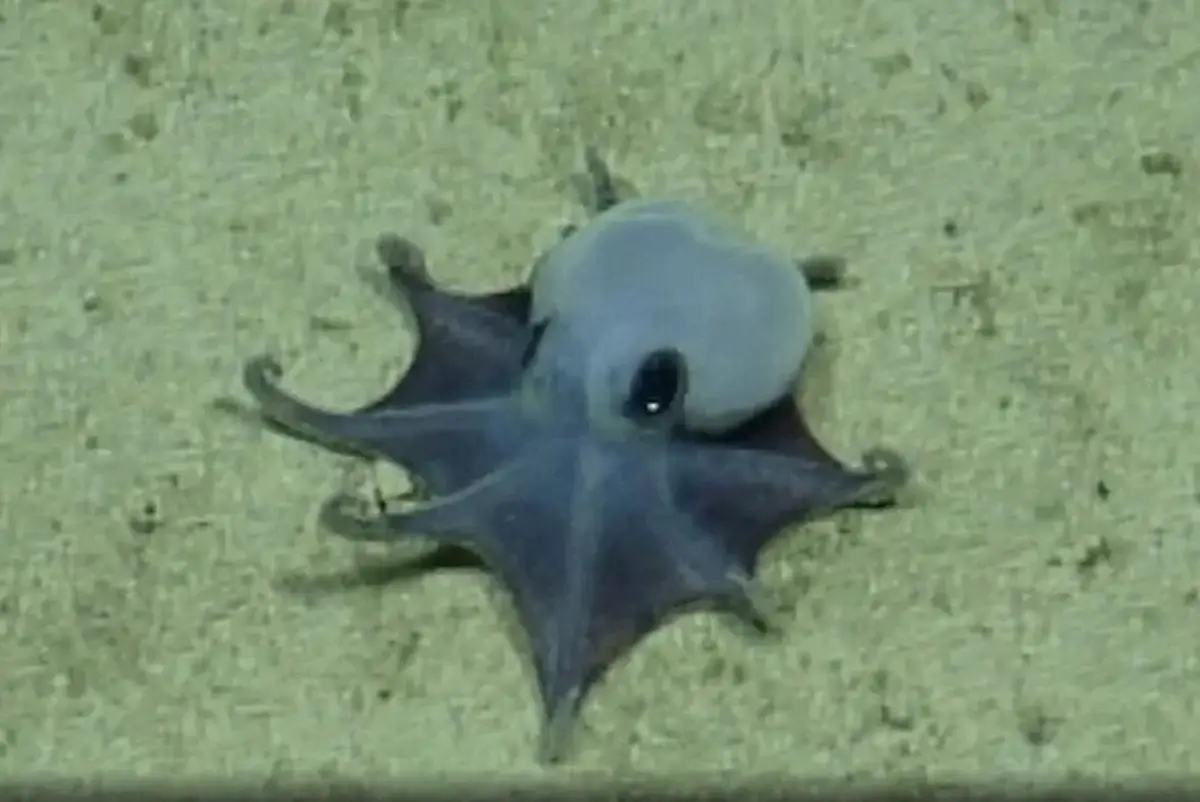
Scientists reckon that the unusual colouring is a way of protecting itself. If the octopus catches prey that emits light, this could attract the attention of predators. The dark underside of the body probably helps absorb this light and camouflage the animal.
As well as its rare blue colour, the “little one” has other distinctive features. It’s got unusually soft skin on its upper body, and its thick tentacles with a single row of suction cups are different to those of most other octopus species. Apparently, the species that looks most similar lives off the coast of Uruguay – in fact, in a different ocean, on the opposite side of South America.
Usually, to accurately identify an octopus species, scientists have to dissect the animal to examine its beak, mouthparts, and internal organs. This time, though, the researchers only had one specimen and didn’t want to damage it.
Instead, the team used micro-CT scans to create thousands of high-res images, which they then used to build a 3D model of the octopus. This meant they could study even the smallest details of the animal’s internal structure without having to dissect it.