
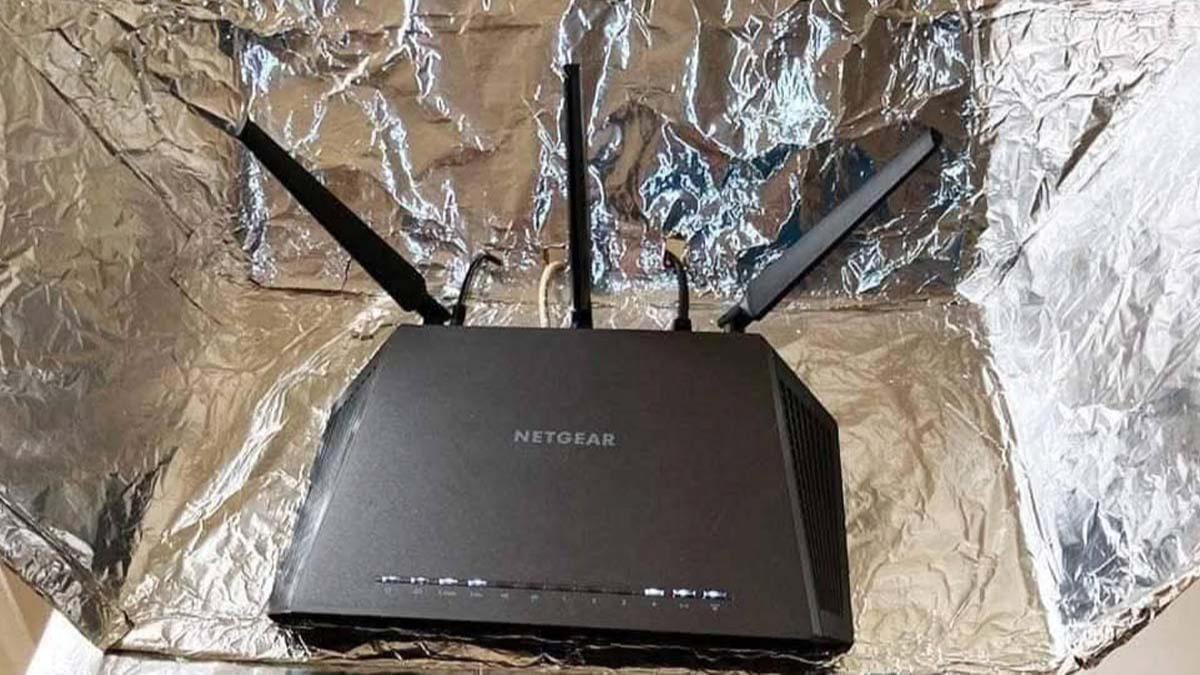

There’s this popular life hack that uses aluminum foil to boost Wi-Fi, and science has confirmed that it works. Research from Dartmouth College has shown that if you bend a piece of foil into a “C” shape and place it behind the router’s antennas, it’ll act as a directional reflector. This lets you send radio waves to wherever you need them, boosting network throughput by up to 50%. But experts say this method doesn’t make the signal stronger. It just moves it around, which can create “dead zones” in other parts of the room.
There’s an old home hack that’s making waves again: putting aluminum foil behind your router to boost the Wi-Fi signal. And despite the skepticism, some studies show that the trick can actually work—if you do it right.
The idea isn’t new. They used foil before to boost TV and radio signals. Nowadays, people are trying to apply this approach to Wi-Fi networks, where the signal also travels as radio waves. But the big question is whether this actually helps, as BGR writes.
There was an interesting experiment at Dartmouth College’s Department of Computer Science. The researchers studied how reflectors affect Wi-Fi signal distribution and concluded that a properly shaped reflective surface can control the direction of coverage and amplify the signal in specific areas.
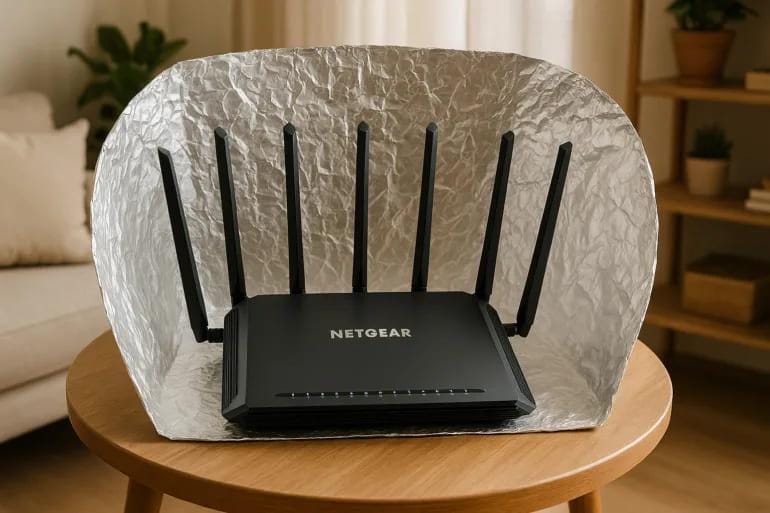
We found out during testing that aluminum foil can actually work as a basic reflector of radio waves. It can “redirect” the signal in a specific way, which reduces signal loss in one area and boosts coverage in another. In some cases, they saw a bandwidth increase of up to 50% or more.
But this effect isn’t universal. The foil doesn’t make the internet faster, but it does help to spread the signal more evenly. So, when you improve one part of a room, you might end up with “dead zones” in another.
How to boost your router’s signal using aluminum foil
The simplest option is to fold a sheet of aluminum foil into a slightly curved shape resembling the letter “C.” Just place it behind the router’s antennas. This shape helps send the signal forward and reduce it going back.
Just don’t wrap the router completely in foil. The effect works specifically as a directional reflector, which is why the foil goes behind the router, not on the sides or top. Otherwise, you might actually worsen the signal quality.
After you install it, it’s a good idea to play around with the angle and the distance from the antennas. Even a little change in position can make a big difference in signal distribution in the room.
Basically, aluminum foil works like an “optimized reflector” — sort of like a basic antenna. In theory, this could help eliminate dead zones or improve connection stability, but the result depends a lot on the shape, angle, and placement of the structure.
So, experts see this method more as an experiment than as a reliable way to improve network performance.