
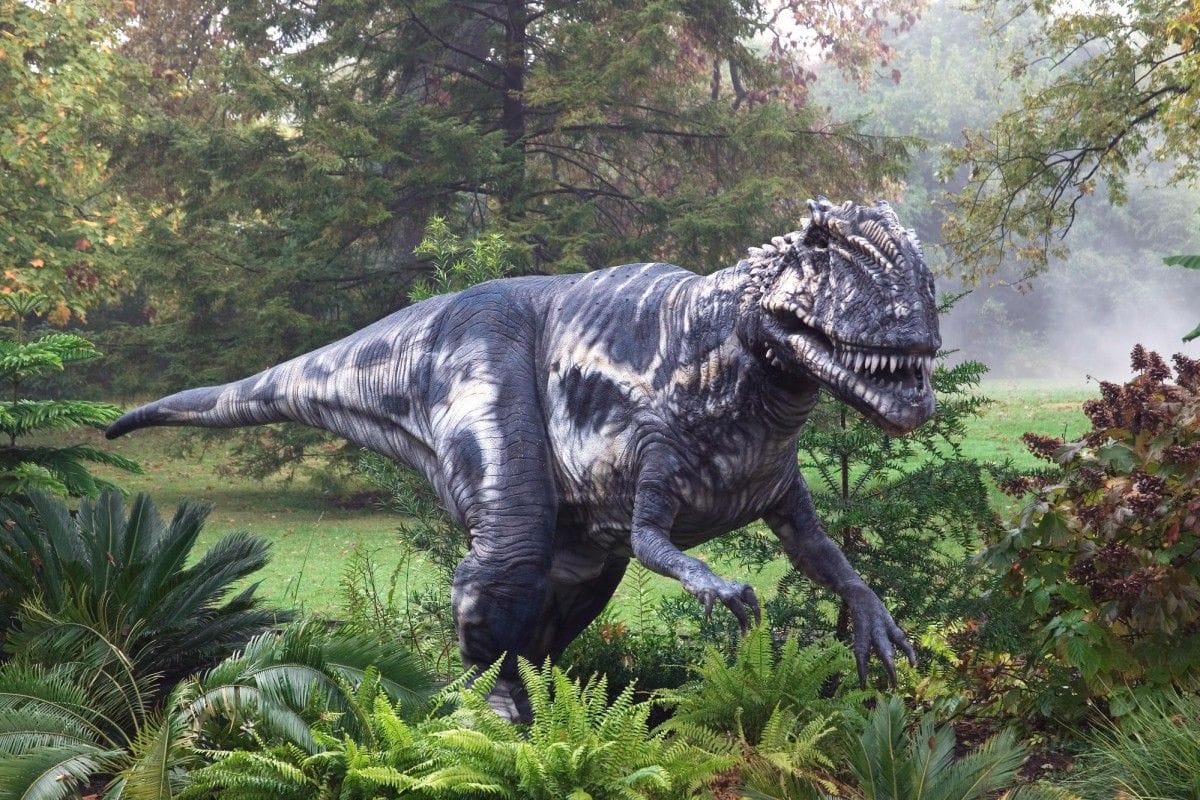

There’s a new study out that explains why T. rex and other big predatory dinosaurs had such tiny front legs. It’s not what you’d expect, based on what we thought we knew about evolution. Researchers found a strong link between limb reduction and increased skull strength and power. But then, they started to face some huge competition—like giant sauropods. So, they had to switch things up and start hunting with their jaws instead of their claws. The head took over the hands’ main role in attacking, and over time, the forelimbs got smaller because they weren’t being used much. T. rex had the strongest skull of all the theropods we studied. We figured this out by looking at the bone density and bite force.
A new study says that big, scary dinosaurs like Tyrannosaurus rex had tiny front paws because they mostly used their heads as weapons. The Independent says that the T. rex was a huge dinosaur that grew up to 12 meters long and 6 meters tall, but had teeny-tiny front limbs—about 0.9 meters long, which is about the same as a human’s.
Researchers say that the tiny front limbs of these huge dinosaurs are linked to the development of their big, strong skulls, showing a shift toward hunting with their heads and jaws instead of their claws.
This change in their bodies happened at the same time as the increase in the size of their prey—giant long-necked herbivorous sauropods and other large herbivorous dinosaurs.
“We wanted to figure out what caused this change, and we found a strong link between short arms and large, powerfully built heads,” said Charlie Roger Sherer, the author of the study published in the journal Proceedings of the Royal Society B: Biological Sciences.
“The head took over the function of the arms as a means of attack. It’s all about making the most of it while it’s still around. The arms were no longer useful and shrank over time,” Scherer explained.
Giant heads in dinosaurs first appeared in areas where there was a lot of big prey. In this prehistoric world, trying to grab and hold a 100-foot sauropod with claws was less effective than attacking and holding it with jaws.
The bigger prey probably led to an “evolutionary arms race,” where dinosaurs developed strong skulls and jaws to better take down their prey.
In the study, the scientists measured skull strength by looking at its size, the density of the skull’s bone joints, and jaw bite force. They found that T. rex scored the highest, followed by Tyrannotitan, another bipedal dinosaur that was almost the same size as T. rex. Tyrannotitan lived in what is now Argentina during the Early Cretaceous period, which was 145–100 million years ago.
They also compared arm length to skull size across five groups of dinosaurs and found that a reduction in forelimb size was more closely linked to skull strength than to skull size itself or overall body size.
The researchers said that even some predatory dinosaurs with big heads and tiny forelimbs were actually pretty small overall.
They said that the reduction of the forelimbs was probably a result of their redundancy during prey capture in these large theropods.