
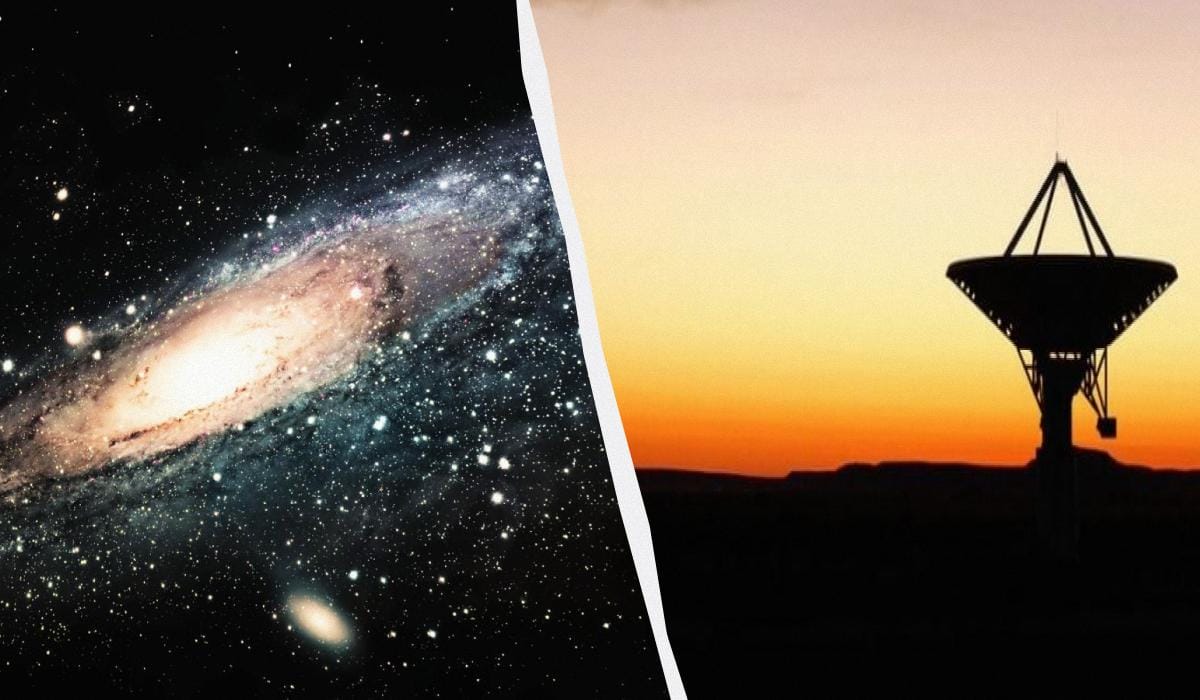

Back in 1933, Karl Jansky, an engineer at Bell Labs, was trying to figure out what was causing static interference in long-distance radio communications. He built a rotating antenna to do this, and while he was working on it, he accidentally detected a mysterious cosmic radio signal. He figured out that the noise was related to stars because of the sidereal repetition period (every 23 hours and 56 minutes). Turns out the highest concentration of radiation comes from the center of the Milky Way (the constellation Sagittarius). This discovery, which was published in Nature, completely changed the game for astronomy. Before, astronomy relied only on optical telescopes, but this new discovery led to the creation of radio astronomy as a new scientific field.
Back in 1933, Bell Labs engineer Karl Jansky found a strange radio signal from space while looking into problems with long-distance communications. This turned out to be one of the most important discoveries in modern astronomy. According to indiandefencereview, at that time, astronomers only used optical telescopes to study celestial bodies. Jansky’s discovery showed that stars and other celestial bodies send out energy in the form of radio waves that can be picked up here on Earth. This discovery totally changed the direction of astronomical research and opened up a completely new field of observation.
While working at Bell Telephone Laboratories in New Jersey, Jansky was tasked with figuring out what was causing static electricity interference in long-distance radio communications. To do his research, he built a big rotating antenna that could track the direction of incoming interference signals as they moved across the sky.
But during his observations, Jansky detected a hissing sound that was unlike the usual radio interference. At first, he thought the noise was coming from nature or something man-made. But the signal was acting weirdly, totally different from anything he had ever recorded before.
The hissing happens every 23 hours and 56 minutes, which lines up with the so-called sidereal period. This timing suggested that the source was related to the stars, not Earth-based activity or the Sun.
Jansky said the signal came from a fixed spot in space. While working on the project, he found the strongest concentration of radio emissions heading towards the constellation Sagittarius. This area is right near the middle of the Milky Way galaxy.
The journal Nature later published the results, and they confirmed that the radiation came from the Milky Way itself, not from solar activity.
A New Branch of Astronomy
Before Jansky’s observations, the Milky Way was never known as a source of radio signals. Space was thought to be radio-quiet, and astronomy was all about observations in visible light.
Before Jansky’s research, astronomers only used visible-light telescopes to learn about celestial bodies. Images and observations were limited to what could be seen directly with optical instruments.
Jansky’s discovery introduced a whole new way of doing things. It turns out that stars and other celestial objects emit radio waves that can be detected from Earth. This laid the foundation for radio astronomy. This led to a new way of studying the universe that astronomers still use today.