
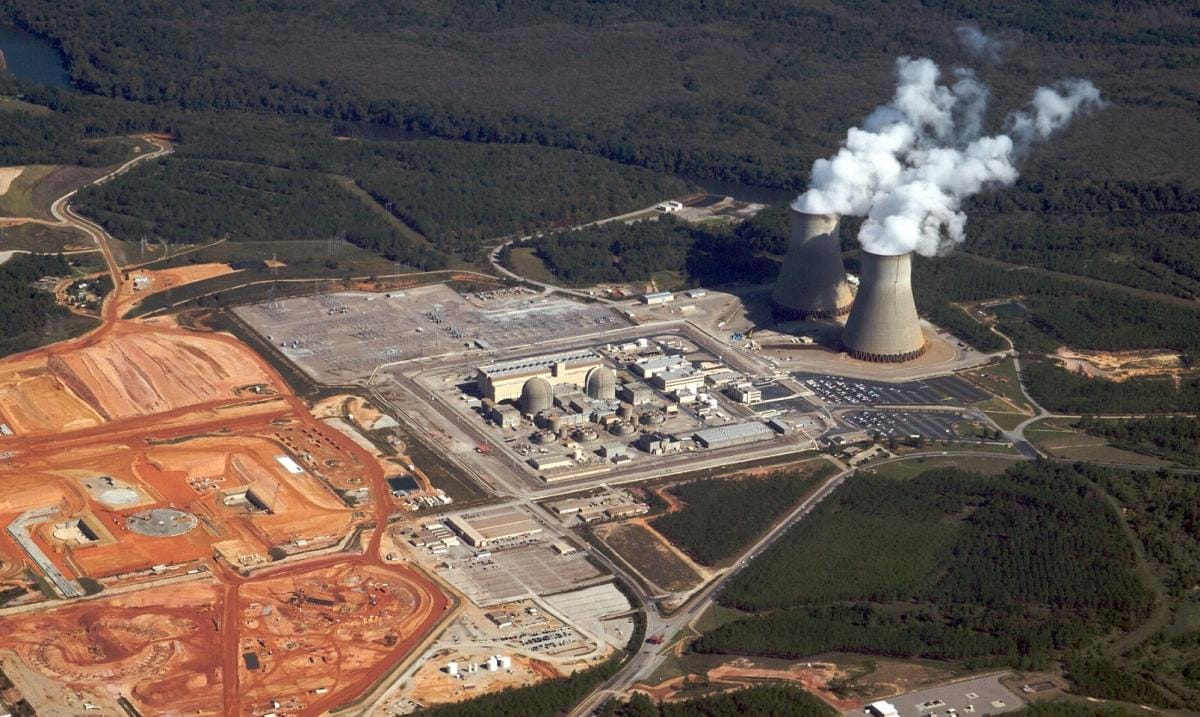

While building the Vogtle nuclear power plant in Georgia, USA, workers found some pretty rare fossils – they were from a prehistoric creature that was about 4 metres long and 40 million years old! The find turned out to be an ancestor of modern whales from the Eocene epoch and was named Georgiacetus vogtlensis. Palaeontologists from the University of South Georgia discovered that the animal’s pelvis was no longer stuck to its spine, like land mammals, which meant it couldn’t walk. It also kept the attachment points for its back legs, which it used for swimming. This discovery gave us a really important glimpse into how whales started living exclusively in the sea.
While building the Vogtle nuclear power plant in Georgia, construction workers stumbled upon some incredibly well-preserved fossils dating back 40 million years. Under all that soil there were the remains of a strange creature about 4 metres long. At first, the workers thought the bones belonged to a bunch of different animals whose remains had just got all mixed up.
But then, palaeontologists took a closer look. The skeleton belonged to one person who lived around 40 million years ago, when this area was at the bottom of a shallow prehistoric sea, according to The Pulse. So, how’s this discovery going to change the way we research whale evolution?
We found it while we were working on the Vogtle site in eastern Georgia. The site later became a large nuclear power station
The nuclear power station construction site turned into a palaeontological dig. Workers unearthed dozens of large bones. At first, no one really knew what they belonged to. The remains were surprisingly well-preserved for a marine fossil.
Researchers from the University of South Georgia got involved in the excavation pretty quickly. This decision turned out to be a real game-changer. The researchers realised that the creature’s pelvis was no longer firmly attached to its spine. Some of the segments were still in their original underground position.
This gave the scientists a rare advantage. They were able to study exactly how the animal died and how it ended up on the seabed. The researchers also extracted the surrounding layers of sediment. These layers helped to work out how old the fossils were.
The remains dated back to the Eocene epoch. Back then, most of Georgia was underwater. The coastline looked nothing like it does now. Warm, shallow seas covered large areas of the south-east.
Then we found out some more info. The creature had features of both ancient and modern whales. This meant we had to change the direction of the investigation straight away.
The fossil was a bit of a puzzle to begin with, but the researchers eventually figured it out. Turns out, early whale ancestors weren’t as sophisticated as we might have thought. A lot of them still had a strong connection to land mammals. But this animal just seemed different.
It looked like it had fully adapted to life in the water. Its pelvis wasn’t stuck to its spine anymore. Modern whales share this same feature today. This suggests that the creature spent almost its entire life swimming. It probably wouldn’t have been able to walk on land by then.
But you could still see where the attachment points for the hind legs were on the fossil. The researchers were pretty surprised by this. The animal looked like it was stuck between two stages of evolution. It’s not fully modern, but it’s not ancient either. This combination made the find extremely valuable.
Afterwards, the researchers compared this fossil with some even older proto-whales from Asia. The similarities were impossible to ignore. It looks like the animal from Georgia was related to those early species. But it also had features that led to modern whales. This helped scientists trace the migration of whales through ancient oceans. It’s likely that the animal used its powerful hind legs to swim instead of its flippers.
The fossil helped researchers understand how semi-aquatic mammals evolved into creatures that live on land. Even the Nuclear Regulatory Commission wanted to find out what this animal was.
So, this four-metre-long creature was actually a prehistoric whale. We named it Georgiacetus vogtlensis. Its name literally means ‘whale from Georgia, found at Vogt Station’.
Scientists found a few individual specimens at the dig site. One skeleton was in really good condition. The researchers think the animal was between 3.3 and 4 metres long. Its skull alone was almost 76 centimetres long.
This species was around 40 million years ago. This is what the whales were like way back when they were still long-necked swallows. But now, researchers think it’s actually pretty linked to their family history. Maybe that’s the case for a lot of the modern whale species.
Why’s this discovery still important today?
Well, the fossil’s given us a better understanding of a really important evolutionary transition – how whales went from being land animals to being marine animals.
Earlier whale ancestors were able to move between land and water. Georgiacetus seems to be a later stage. It adapted really well to the open sea. But you could still see some of the old anatomical features. This helped researchers get a better idea about the species’ evolution.
Later on, scientists found similar fossils in Alabama and Mississippi. These finds backed up the initial conclusions from Georgia. Today, the fossils from the Vogt Station site are still one of Georgia’s most significant palaeontological discoveries.
Whales behaved quite differently from their modern-day counterparts. And all this because builders discovered some old bones beneath the site of a future nuclear power station.