
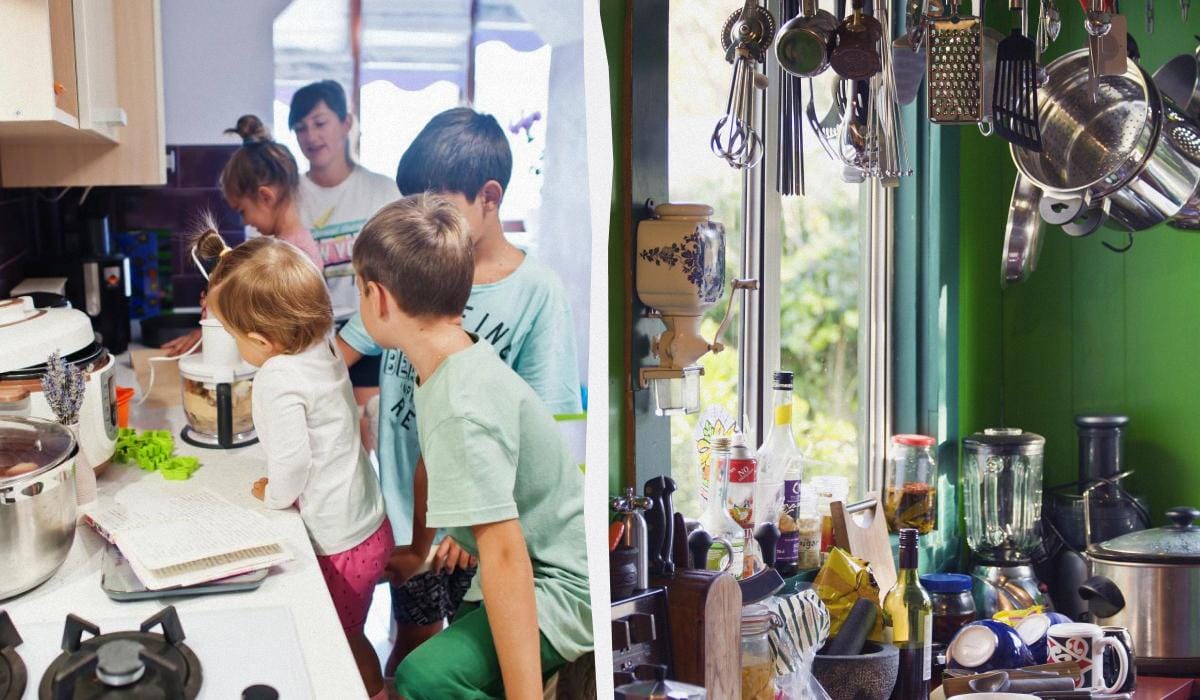

A cramped kitchen is often the result of design errors rather than a lack of space. Experts highlight seven key factors: cluttered countertops, poor lighting (especially in dark corners), massive wall cabinets that feel “oppressive” from above, and an ill-conceived work triangle layout. Designers recommend avoiding kitchen islands in small spaces, organizing cabinet interiors with dividers, and adding under-cabinet lighting. These simple steps will help visually expand the space without a major renovation.
A cramped kitchen isn’t necessarily a small kitchen. Even a spacious room can feel cramped if it’s not properly designed or organized, whether due to the layout, design, or how the space is used. The good news is that you don’t need a major renovation to visually expand your kitchen, according to The Spruce.
Interior designers explained why a kitchen can feel cluttered and how to fix it.
Too many items on the countertops
This is a common mistake. You want to keep your coffee maker, kettle, and other handy items close at hand. However, the more items on the countertop, the less work space is left.
“People often leave small appliances on valuable counter space, even if they hardly ever use them,” notes interior designer Candice Stratton.
A simple solution is to keep only the appliances you use daily out in the open and store the rest in cabinets.
Poor lighting
Dim lighting makes a kitchen look smaller. Poorly placed lighting also makes a kitchen look smaller.
“If the back of the countertop against the wall isn’t lit, it seems to disappear,” Stratton explains.
Try replacing dim bulbs, but keep the wattage limit in mind. You can also install under-cabinet lighting to illuminate dark areas. You can also hang pendant lights above work surfaces.
Heavy Wall Cabinets
When walls are visually overloaded, the eye has nowhere to rest.
“The heavy line of upper cabinets creates a feeling of pressure from above, especially in small kitchens or with dark cabinet fronts,” notes designer Jacqueline Serdi Morrison.
One way to fix this is to remove some of the wall cabinets, replace the doors with glass ones, or add open shelves. Alternatively, you can take the plunge and do away with the “top cabinets” altogether—the kitchen will feel lighter visually.
Poor layout
This mistake is considered to be the most common and expensive one, according to Stratton.
If you’re building or remodeling a kitchen, consider traffic flow. Do people have to walk through the work triangle to get to another room or go outside? Does opening the refrigerator obstruct the person cooking?
“Leave enough room to move around,” she advises. A kitchen may be small, but it must be well planned.
Poor zoning
Every kitchen has zones: for storage, preparation, cooking, and cleanup. If they overlap, chaos and a feeling of cramped space ensue.
“Poor zoning creates unnecessary ‘bottlenecks’ and makes the kitchen look smaller than it is,” says Morrison.
The solution is to increase the distance between zones, especially around the island, where clutter is most noticeable.
Islands in Small Kitchens
“There’s nothing worse than trying to cram an island where it doesn’t belong,” says designer Cheiziti Centeno.
This impairs circulation and creates narrow passageways. If your kitchen is small, consider alternatives: “towers” with appliance niches, lift-up mechanisms in base cabinets, and so on.
“An island requires at least 106 centimeters of clear space on all sides and no fewer than three bar stools. If that’s not possible, do without the island,” she advises.
Disorganized drawers and cabinets
When you open a cabinet and lids of containers spill out at you, it feels like there’s not enough space—and your brain says, “I need more space.”
The solution is organizational systems, such as inserts, dividers, and containers. The easier it is to reach an item, the less clutter there is.
Even a small improvement in ergonomics can make the kitchen feel more spacious.